MINIX
1987 → today · Linux & Unix
A small Unix-like system that Andrew Tanenbaum wrote for teaching.1 Its full source code came with his 1987 textbook.1, 2
- Written by
- Andrew S. Tanenbaum1
- Design
- A microkernel1
- Newest stable release
- MINIX 3.3.0, as of November 20264
Written for teaching
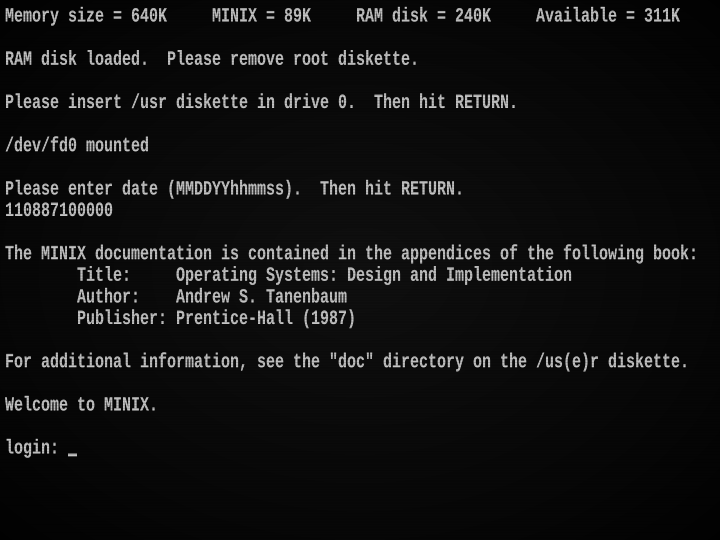
Andrew Tanenbaum taught operating systems using John Lions' book on Unix Version 6. When AT&T forbade teaching how Unix worked inside, he decided to write his own Unix-like system, free of AT&T code, and did it alone.1 He called it MINIX. Its full source code was printed in his 1987 book Operating Systems: Design and Implementation, and Prentice Hall sold the floppy disks for $69.1
Small and tidy
MINIX was a microkernel: the memory manager and the file system ran as separate programs, outside the kernel. Tanenbaum says this made it cleaner and more reliable, and that it started in about 5 seconds, even on a 4.77 MHz 8088 processor.1 Its Usenet newsgroup, comp.os.minix, had 40,000 subscribers.1 One user was a Finnish student, Linus Torvalds, who learned from the book and went on to write Linux.2
MINIX today
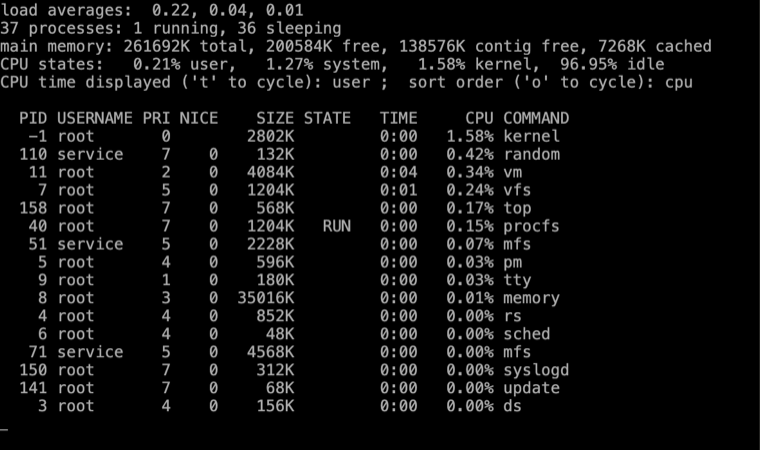
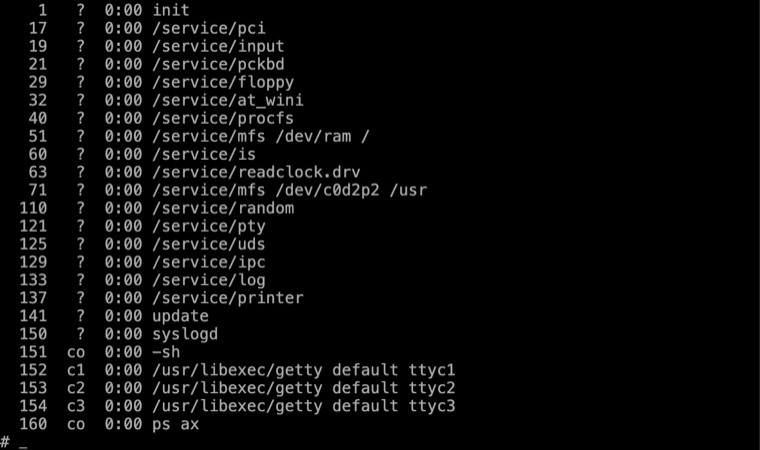
With MINIX 3, in 2006, the emphasis changed from teaching to a serious research and production system.2 If a driver crashes, MINIX 3 restarts it, and running programs don't even notice.3 Since 2000, MINIX has used the Berkeley license, which lets companies use it freely.2, 6 As of November 2026, the newest stable release on its download page is 3.3.0.4
Key moments
- 1987 MINIX comes out with Tanenbaum's book Operating Systems: Design and Implementation.1, 2
- 1991 On 25 August, Linus Torvalds tells comp.os.minix readers about his own free system and asks what they like in MINIX.5
- 1997 A second version of MINIX comes with the book's second edition, written with Albert Woodhull.2
- 2006 MINIX 3 comes out with the book's third edition.2